
You Are Not an Insect.
We're sorry to tell you that your verification has failed. You picked ultraviolet blocks with all the confidence of someone who cannot see ultraviolet light, which is to say, a human.
A real insect would have found this trivially easy. You, however, were staring at a grid of nearly identical pale lavender squares and hoping for the best.
Your booking has not been confirmed.
"Butterflies may have a slightly lower visual acuity than ourselves, but in many respects they enjoy a clear advantage over us: they have a very large visual field, a superior ability to pursue fast-moving objects and can even distinguish ultraviolet and polarized light."
Kentaro Arikawa, Professor of Biology, Sokendai
What Insects See That You Cannot
You just failed a test that most of The Insect Hotel's guests would pass without thinking. But what exactly do they see that you don't? The answer depends on the guest.
Different insects have very different visual systems. Some see three colours. Some see fifteen. Some see polarised light, shimmering structures on petals, or UV nectar guides painted across flowers like runway markings. The world they live in is richer, stranger, and more colourful than anything a human eye can pick up.
Still here? Good. Here's what they actually see.
The Honeybee: Where It All Started
In 1914, Karl von Frisch proved that honeybees can see colour. He trained them to collect sugar water from a blue card placed among grey cards of different brightness. The bees chose blue every time. He went on to win a Nobel Prize for his life's work on how bees sense and communicate.
But bee colour vision is not like ours. Humans have three colour sensors (red, green, blue). Honeybees also have three, but shifted toward shorter wavelengths: ultraviolet, blue, and green. This means bees can see ultraviolet light but cannot see red. A red poppy looks dark and colourless to a bee. But a white clover flower, plain to us, blazes with UV patterns that guide the bee straight to the nectar.
Later research by Randolf Menzel confirmed that bee colour vision works on the same principles as ours, but shifted into a completely different range of light.
Solitary Bees: The Hotel's Core Guests
The Insect Hotel is built for solitary bees (leafcutter bees, carpenter bees, and other cavity-nesters), not honeybees. So what do they see?
Like honeybees, solitary bees see in three colours: UV, blue, and green. But their green sensor is shifted slightly toward longer wavelengths, making them more sensitive to the yellow-orange end of the spectrum. This may be an adaptation to the specific flowers they visit. Studies show they tell colours apart at least as well as honeybees, and possibly better.
Leafcutter bees are also sharp navigators. They learn the positions of edges and landmarks around their nest entrance and can find their chosen chamber with remarkable precision, even in a wall of identical-looking tubes.
What this means for The Insect Hotel: When a solitary bee approaches the hotel, it sees the flowers around it in UV, blue, and green: a completely different palette from yours. The bamboo tubes and drilled wood, which look plain brown to you, likely show a more complex pattern of UV-reflecting and UV-absorbing surfaces. The bee sees the layout in a way you never will, and navigates it better than you ever could.
Butterflies: Fifteen Types of Light Sensor
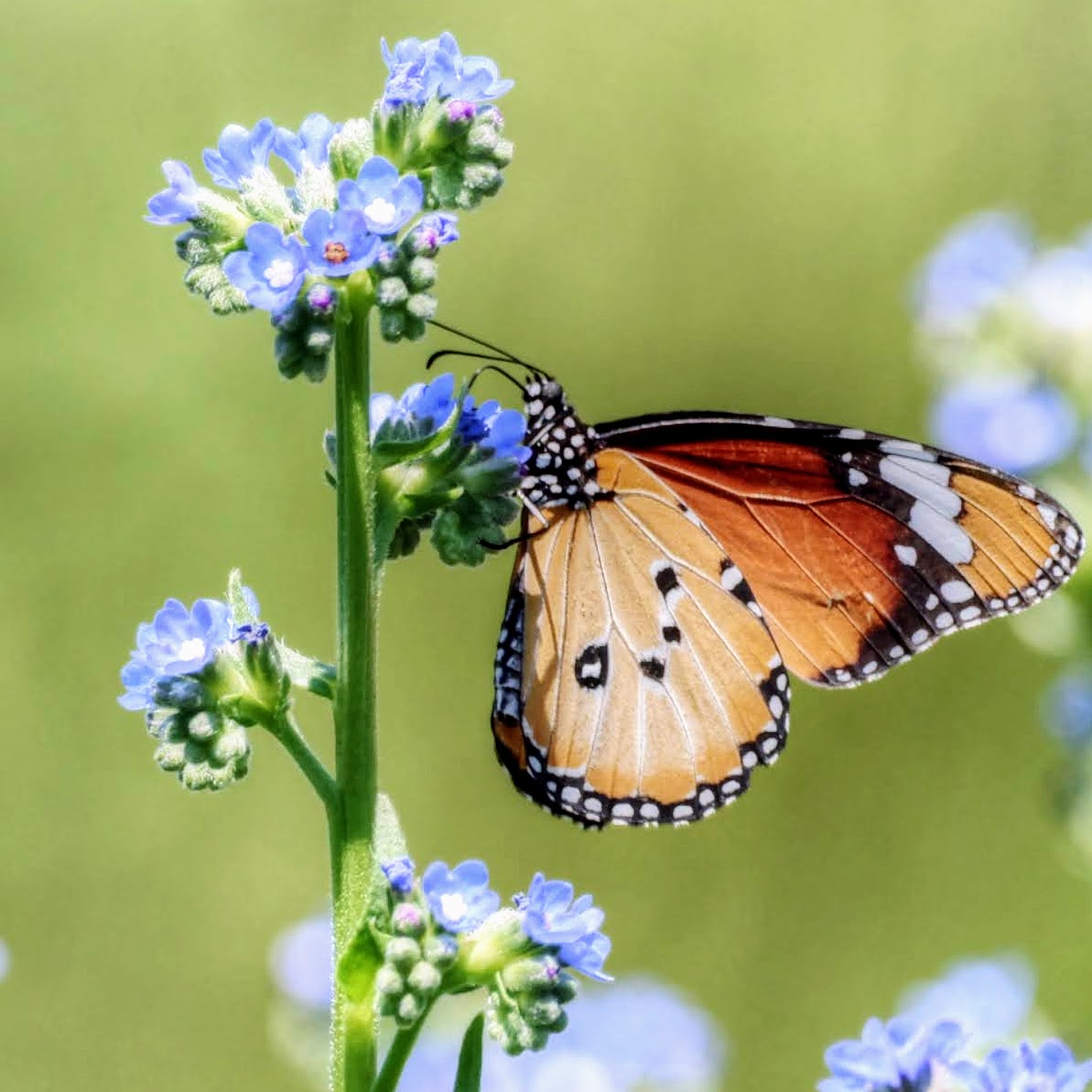
If bees see three colours, butterflies are something else entirely.
In 2016, Kentaro Arikawa and colleagues at Sokendai (the Graduate University for Advanced Studies, Japan) published a landmark finding: the Common Bluebottle butterfly (Graphium sarpedon) has 15 distinct classes of light sensor, the most ever found in any insect. They cover everything from ultraviolet to multiple shades of red, with stops at violet, blue, green, and orange along the way.
Before this, no insect was known to have more than nine.
"We have studied color vision in many insects for many years, and we knew that the number of photoreceptors varies greatly from species to species. But this discovery of 15 classes in one eye was really stunning." Kentaro Arikawa
But the butterflies don't use all fifteen for everyday colour vision. Arikawa's team showed that the Bluebottle likely uses four sensors for general colour and uses the other eleven for special tasks: spotting fast-moving objects against the sky, finding colourful objects hidden in foliage, or recognising mates.
Earlier work on the Asian Swallowtail showed that its six light sensors give it four-colour vision (UV, blue, green, red), matching human colour discrimination in certain ranges and beating it in others.
What this means for The Insect Hotel: A butterfly passing through the garden sees the hibiscus and Brunfelsia flowers in a richer palette than you can imagine. Not just the pinks and purples you see, but extra channels of UV patterning and fine colour differences that create a different flower entirely. The "white" hibiscus in the garden likely carries UV markings that make it a vivid, high-contrast target.
Hoverflies: Yellow Means Food
Hoverflies are another common hotel visitor, and their eyes work differently again. Flies have four types of light sensor, laid out nothing like a bee's: UV, blue, green, and a theoretical purple zone.
But hoverflies have a striking quirk: they are born with an unshakeable love of yellow. A hoverfly that has never seen a flower will reach out its tongue toward yellow things and land on yellow surfaces. This preference can't be overridden by training. Even flies raised on blue-coloured food still prefer yellow.
Recent research has shown that hoverflies actually tell colours apart along a smooth scale, more like bees than scientists previously thought.
What this means for The Insect Hotel: When a hoverfly arrives, it heads first for yellow flowers in the garden. The Brunfelsia's purple blooms may be less appealing; the yellow centres of other flowers will pull it in. It sees the insect hotel's wooden surfaces differently from a bee. The four-channel system creates a different visual reading of the same bamboo and bark.
Lacewings: Eyes Built for Darkness
Green lacewings are mostly active at night, and their eyes reflect this. Unlike the standard compound eyes of bees, lacewings have superposition eyes: large, golden-shimmering half-spheres that gather far more light per sensor. This lets them see in near-darkness.
Their eye sensitivity changes hugely through the day: highest at midnight, lowest at noon. The eye does this by physically adjusting its opening, widening at night to let in more light. They're most sensitive in the green and UV ranges, tuned to the wavelengths that matter most in a moonlit garden.
What this means for The Insect Hotel: A lacewing arriving at dusk sees the hotel in a way no daytime visitor does. Its superposition eyes pull in the fading light. They make the structure visible long after it would vanish from human sight. The lacewing picks up UV signatures from nearby plants and navigates to the bark gaps and straw bundles where it shelters, all in conditions you'd call darkness.
Dragonflies: The Peak of Insect Vision
Dragonflies don't usually check into insect hotels, but they may patrol the garden. Their eyes are in a class of their own.
Each dragonfly compound eye holds up to 30,000 individual lenses (compared to roughly 5,000 in a honeybee), and they carry more light-sensing genes than any other insect group, rivalling the mantis shrimp.
Over 80% of a dragonfly's brain is devoted to processing what it sees. Their compound eyes are split into zones: the upper half holds UV and blue sensors for spotting prey against the sky. The lower half holds green and orange sensors for tracking objects on the ground. They also detect polarised light, which helps them find water and navigate by skylight.
The Hidden Signals: UV Nectar Guides and Structural Colour
Insects don't just see differently. The flowers have evolved to take advantage of it.
Nectar guides
Many flowers carry UV-absorbing patterns, called nectar guides, that are invisible to the human eye. They form bold, high-contrast landing targets for pollinators. A sunflower that looks plain yellow to you is, under UV photography, a dramatic two-toned bullseye: UV-absorbing petals at the tips around a bright UV-reflecting centre. The whole flower is a signal. And the signal isn't meant for you.
These patterns have been found across hundreds of species, from daisies and buttercups to evening primroses and marsh marigolds.
The blue halo
In 2017, researchers at Cambridge published a remarkable finding in Nature: many flowers produce a "blue halo" caused by tiny, disordered ridges on their petal surfaces. These nano-ridges are slightly uneven, imperfect in ways that are the same across unrelated flower families. They scatter light mostly at short wavelengths (UV and blue).
The researchers made artificial flowers with different levels of surface texture and tested foraging bumblebees. The bees could detect and learn to use the blue halo, even when the underlying pigment colour was the same. These tiny structures had evolved, independently and repeatedly, to produce a visual signal aimed specifically at insect pollinators.
Polarised Light: The Invisible Compass
Many insects can detect the polarisation of light, a property completely invisible to the human eye. Polarised light patterns in the sky, created by sunlight scattering in the atmosphere, form a compass that works even on cloudy days.
Desert ants are the textbook example. They use polarised skylight to navigate vast, featureless desert landscapes. But bees use it too. Karl von Frisch himself showed that honeybees orient their waggle dances using polarised light patterns.
Dragonflies use polarisation sensitivity to find water surfaces (which strongly polarise reflected light) and for navigation via the top rim of their compound eyes.
What The Insect Hotel Looks Like to Its Guests
When you look at The Insect Hotel, you see a charming wooden structure with bamboo tubes, slatted wood, and drilled holes. Brown and cream. Simple.
An insect sees something else entirely:
A solitary bee approaching the hotel sees the bamboo tubes as a mosaic of UV-reflecting and UV-absorbing surfaces. The flowers nearby are not just purple and white; they carry bold UV nectar guides and shimmering blue halos on their petals. The bee has memorised the exact arrangement of visual edges around its chosen chamber and navigates back with pinpoint accuracy.
A lacewing arriving at dusk sees the hotel's outline picked out by superposition optics long after human vision would fail. The green-and-UV sensitivity of its sensors picks out the bark textures and straw bundles where it will shelter. By midnight, its eyes are at peak sensitivity, and the garden is far from dark.
A hoverfly scans the garden through four-channel colour vision. It locks onto the yellow it is born to approach, then uses motion-sensitive neurons to hover precisely near the flower heads. The insect hotel's wooden surfaces register in its fly-specific colour space, a different visual experience from the bee's.
A visiting butterfly sees the garden through up to fifteen types of sensor, picking up fine colour differences in flower petals that neither you nor the bee can detect. The hibiscus blossom is not just white-and-pink: in the butterfly's expanded visual range, it may be a completely different colour.
All of them can see the ultraviolet blocks you just failed to identify.
Why This Matters
Understanding insect vision has real-world effects:
- Conservation. If we design pollinator gardens based on how they look to humans alone, we may plant flowers that appeal to us but send poor signals to the bees and hoverflies we're trying to attract. UV-reflective species and those with strong nectar guides work far better.
- Agriculture. Pesticide residues can change the UV-reflectance of treated flowers, which may disrupt the visual signals that guide pollinators to crops.
- Lighting. Artificial light at night, especially UV-emitting lights, is devastating to nocturnal insects like lacewings. Switching to longer-wavelength, insect-friendly lighting means understanding what insects actually see.
- Appreciation. The natural world contains information, beauty, and communication that is entirely invisible to human eyes. The garden around The Insect Hotel is full of signals you will never see, and every one of them is there for a reason.
So, What Now?
You're not an insect. You can't check in to The Insect Hotel. But you can do something arguably better:
Build one.
An insect hotel in your garden provides vital habitat for solitary bees, lacewings, ladybirds, and other helpful insects. Use bamboo tubes, drilled logs, pine cones, bark, and bundles of hollow stems. Face it north-east. Place it near flowering plants, especially those with strong UV nectar guides. And then step back and let the real guests arrive.
They'll see things you never will. And they'll appreciate it more than you know.
How do we know?
The science on this page draws on over a century of research into insect vision. Here are the key studies.
- Von Frisch, K. (1914). Demonstration of colour perception in bees. Zoologische Jahrbücher
- Menzel, R. & Blakers, M. (1976). Colour receptors in the bee eye: morphology and spectral sensitivity. Journal of Comparative Physiology A
- Menzel, R., Steinmann, E., de Souza, J. & Backhaus, W. (1988). Spectral sensitivity of photoreceptors and colour vision in the solitary bee, Osmia rufa. Journal of Experimental Biology
- Peitsch, D. et al. (1992). The spectral input systems of hymenopteran insects and their receptor-based colour vision. Journal of Comparative Physiology A
- Troje, N. (1993). Spectral categories in the learning behaviour of blowflies. Zeitschrift für Naturforschung
- Kral, K. & Stelzl, M. (1998). Daily visual sensitivity pattern in the green lacewing Chrysoperla carnea. European Journal of Entomology
- Hempel de Ibarra, N., Vorobyev, M. & Menzel, R. (2014). Mechanisms, functions and ecology of colour vision in the honeybee. Journal of Comparative Physiology A
- Futahashi, R. et al. (2015). Extraordinary diversity of visual opsin genes in dragonflies. Proceedings of the National Academy of Sciences
- Chen, P-J., Awata, H., Matsushita, A., Yang, E-C. & Arikawa, K. (2016). Extreme spectral richness in the eye of the Common Bluebottle butterfly, Graphium sarpedon. Frontiers in Ecology and Evolution
- Arikawa, K. (2017). The eyes and vision of butterflies. Journal of Physiology 595(16): 5457–5468
- Moyroud, E. et al. (2017). Disorder in convergent floral nanostructures enhances signalling to bees. Nature 550: 469–474
- Hannah, L. et al. (2019). Psychophysics of the hoverfly: categorical or continuous colour discrimination? Current Zoology 65(4): 483–492
- Horridge, G.A. et al. (1975). The eyes of the hoverfly Eristalis tenax. Proceedings of the Royal Society B